Choosing the right body trimmer manufacturer is one of the most important decisions a B2B buyer can make. A supplier does more than produce goods. They influence your product quality, delivery performance, customization options, and even your brand reputation in the market. A low price may look attractive at the start, but the wrong manufacturing partner can create delays, inconsistencies, and expensive after-sales problems.
For that reason, smart buyers do not judge a factory by quotation alone. They look at the full picture, including production capability, communication speed, quality control, and how well the supplier fits their long-term business goals. Before you move forward with any order, these seven checks can help you make a safer and more strategic decision.
1. Check whether the factory really matches your product category
Not every factory that makes personal care products is a strong body trimmer manufacturer. Some suppliers only assemble standard models, while others have deeper experience in blades, motor systems, waterproof structure, and grooming accessories. That difference becomes more important once you need stable quality or custom development.
A buyer may receive similar quotations from several suppliers, but the results can be very different after sampling begins. A manufacturer with real body trimmer experience usually asks sharper questions about runtime, guard comb sizes, charging method, and housing design. That is often the first sign that the supplier understands the category instead of simply trying to win an order.
2. Check communication speed and clarity before production starts
Early communication often predicts later project performance. If a supplier is slow to answer simple technical questions before receiving the order, they are unlikely to become more responsive once production is underway.
Many buyers only realize this too late. One distributor may choose a supplier based on a favorable unit price, then spend weeks waiting for packaging confirmation, logo placement approval, or revised samples. Delays like these do not come from the product alone. They come from weak project management. A reliable body trimmer manufacturer should answer clearly, confirm details in writing, and keep the project moving without repeated confusion.
3. Check sampling quality, not just the final quotation
The sample stage tells you far more than the quotation sheet. It shows whether the manufacturer can follow instructions, control details, and translate your requirements into a real product.

For example, a buyer may request a matte housing finish, a custom color box, and a specific accessory layout. If the sample arrives with inconsistent logo printing, weak tray fit, or missing details, the problem is not only the sample itself. It suggests that mass production may create larger issues. A serious body trimmer manufacturer treats sampling as the first proof of execution, not as a casual step before the real work begins.
4. Check quality control procedures inside the factory
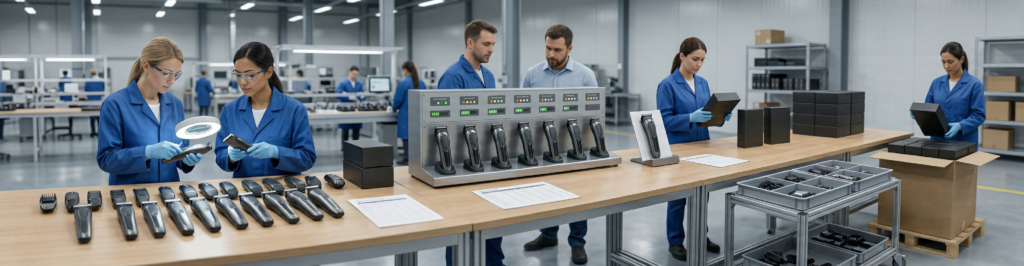
A good-looking sample is not enough if the factory cannot maintain the same standard in bulk production. That is why buyers should ask how inspection is handled during assembly, charging tests, waterproof checks, packaging inspection, and final carton loading.
Some factories rely too heavily on final inspection, which means problems are discovered only after too many units have already been produced. Stronger manufacturers build quality control into every stage of the process. If a supplier can clearly explain their inspection workflow, defect handling, and approval standards, that is a much better sign than a factory that only says, “Quality is no problem.”
5. Check whether the manufacturer can support your customization goals
A body trimmer manufacturer may be good at standard orders but weak in customization. If your business depends on private label, OEM, custom packaging, or accessory changes, you need to confirm those abilities early.
One buyer may want only logo printing and a color box, while another may need housing color changes, accessory upgrades, and a more premium packaging structure. These are very different requirements. The right supplier should be able to explain what is possible, what affects MOQ, and what kind of lead time each customization level requires. Clear answers at this stage reduce misunderstandings later.
6. Check if the factory can grow with your business
A supplier that fits your first order may not fit your second or third one. This is why buyers should think beyond the first shipment. Can the manufacturer handle larger volumes later? Can they support new packaging formats, additional SKUs, or upgraded product versions? Can they maintain delivery stability during peak seasons?

A short-term supplier may help you launch, but a long-term manufacturing partner helps you scale. The best factory relationships are built not only on current capacity but also on future compatibility.
7. Check whether the supplier feels like a partner, not only a vendor
In B2B sourcing, the best results usually come from manufacturers who do more than quote a price. A strong supplier points out risks, asks the right questions, and helps improve details before mistakes become expensive.
That difference matters. A passive vendor waits for instructions. A real manufacturing partner helps protect the project. When a body trimmer manufacturer shows initiative in sampling, packaging, timelines, and quality details, they are usually much easier to work with as your business grows.
Final thoughts
Choosing a body trimmer manufacturer is not only a purchasing decision. It is a brand decision, a quality decision, and a growth decision. Buyers who check category fit, communication, sampling, quality control, customization ability, long-term capacity, and partnership mindset are far more likely to build stable and profitable supply relationships.
The safest choice is not always the cheapest factory on paper. It is the supplier that can consistently turn your requirements into a reliable, market-ready product.